Ever wonder how to reduce the vibration in your hands when riding on rough surfaces? Or how to avoid early onset of fatigue and soreness in your arms and hands?
Well, most of the riders racing Paris-Roubaix or any cyclo-cross events seem to have found the position to minimise vibration and shock induced to their hands and arms. In those races with extremely rough surfaces (cobblestone, dirt), the level of vibration can definetely lead to hand and finger numbness. If you pay attention to the position of cyclists on rough segments of races, you will notice that they tend to ride with their hands on the top of the handlebar. It is somehow surprising since this position makes it harder to keep an aerodynamic posture and to control the bike. Although, avoiding arm fatigue and hand numbness is probably more important in this situation. You can see on the video of the last 40km of Paris-Roubaix 2014, that most cyclists change their position from the drop to the top within one minute of the cobblestone section. (The first cobble section is at 14:00)
Even if you don’t plan to ride on cobblestone soon, every area has his own rough road, so this will be helpful to increase comfort when riding.
A recent study (Lepine et al., 2014) showed that there is 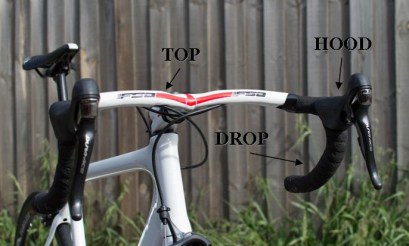 a significant difference in acceleration (vibration) induced at the hands and buttock according to the hands position on the handlebar. In fact, when riding with the hands on the top, there is significantly less vibration than when on the drop, even if the pressure on the handlebar stays the same.
The angle of the wrist also makes a difference in the vibration transmitted through the arms but doens’t affect the saddle. To minimise vibration, the wrist should be kept in a neutral position, meaning aligned with the forearm. Therefore, having the wrists in extension or ulnar deviation should be avoided. This research was made with a small sample of cyclists (2), so can hardly be generalised to the cycling population, but gives good indication of what could be expected.
In the same research, they assessed the impact of the cyclist’s position on vibration, with two different wheel sets. The results were quite different according to the position of the cyclist. The most comfortable wheel set (tested previously with standardised cyclist position) induced more vibration with the cyclist on the brake hood and wrist deviation than the other wheel set with the cyclist having his hand on the top. These results emphasise the importance of the cyclist position on the bike. I would add that the relation between vibration and cyclist position is probably due to the weight of the cyclist which is much more than the bike.
From my physiotherapist point of view, the position of the wrist and elbow when on the top of the handlebar is close to the best position for a joint which is the resting position. This position puts less strain in a joint and correspond to a straight wrist and slightly bent the elbow (70° of flexion). In this position, the joints are more relaxed and can adapt easily to vibration and shocks which decreased the transmission of vibraion through the arms. Riding with the hands on the top has another benefit which is the more upright position that reduces the pressure on the hands.
More tips to improve upper body comfort
- Change position frequently between the drop, the brake hood and the top. Changing position gives you the opportunity to distribute the load on different joints and muscles of your arms, trunk and even using your leg muscles differently.
- Wear good quality gloves with cushion on the loading area of your hand also reduces pressure and prevents early onset of soreness in your hands.
- Make sure you have a good core stability to help support your upper body and to reduce pressure on your hands and arms.
In conclusion, if you ride on rough surfaces, try to put your hands on the top of the handlebar if your riding skills allow you to safely control your bike in this position. Otherwise, changing position, wearing appropriate gloves and having good core stability will make a difference especially for your upper body comfort.
If you want to read more about the research on bike comfort, the complete article: Road bike comfort: on the measurement of vibrations induced to cyclist was published in Sports Engineering (June 2014) and can be found with this link.
I would like to thank my husband who his one of the author of this article and helped me to interpret the engineering materials.
 The Body and The Bike